
Odds and Ends, Part Tres

I’ve written two posts in the past about various odds and ends I’ve found, first in Odds and Ends, and again in Odds and Ends, Part Deux. Both were received by my followers with overwhelming praise and acclaim. Well, I didn’t get any thumbs-down reactions, threats of lawsuits, or other legal action, anyway.
Today, I thought I’d offer a third installment featuring such finds or, as I like to call them, “artefacts.”
The Palco Canteen


The first artefact is this metal canteen. It was manufactured by the Worcester Pressed Aluminum Company, often identified on its products as Palco, in Worcester, Massachusetts.
It is made from, surprise, surprise, pressed aluminum. At the time, aluminum was especially useful for items such as canteens because it was revolutionary at the time for being lightweight, durable, and resistant to rust. The patent date stamped on this style of canteen is May 4, 1915. For a little more information on the history of aluminum, check out my blog post on Souvenirs.
Examples of these canteens are associated with the involvement of the US in World War I (1917-1918), including canteens carried by American servicemen. Similar Palco canteens were also sold for civilian use after the war and were used by outdoor enthusiasts, campers, hikers, and youth organizations, such as the Boy Scouts and Girl Scouts.
Based on several other objects I found nearby, I believe this particular canteen may have been Scout-related, although I can’t prove it.
Disclaimer: I didn’t actually find this one with my metal detector. I was swinging the coil in the area when I “eyeballed” it lying among the leaves. Detectorists have to take their victories wherever they can get them.
The Barrel Tap
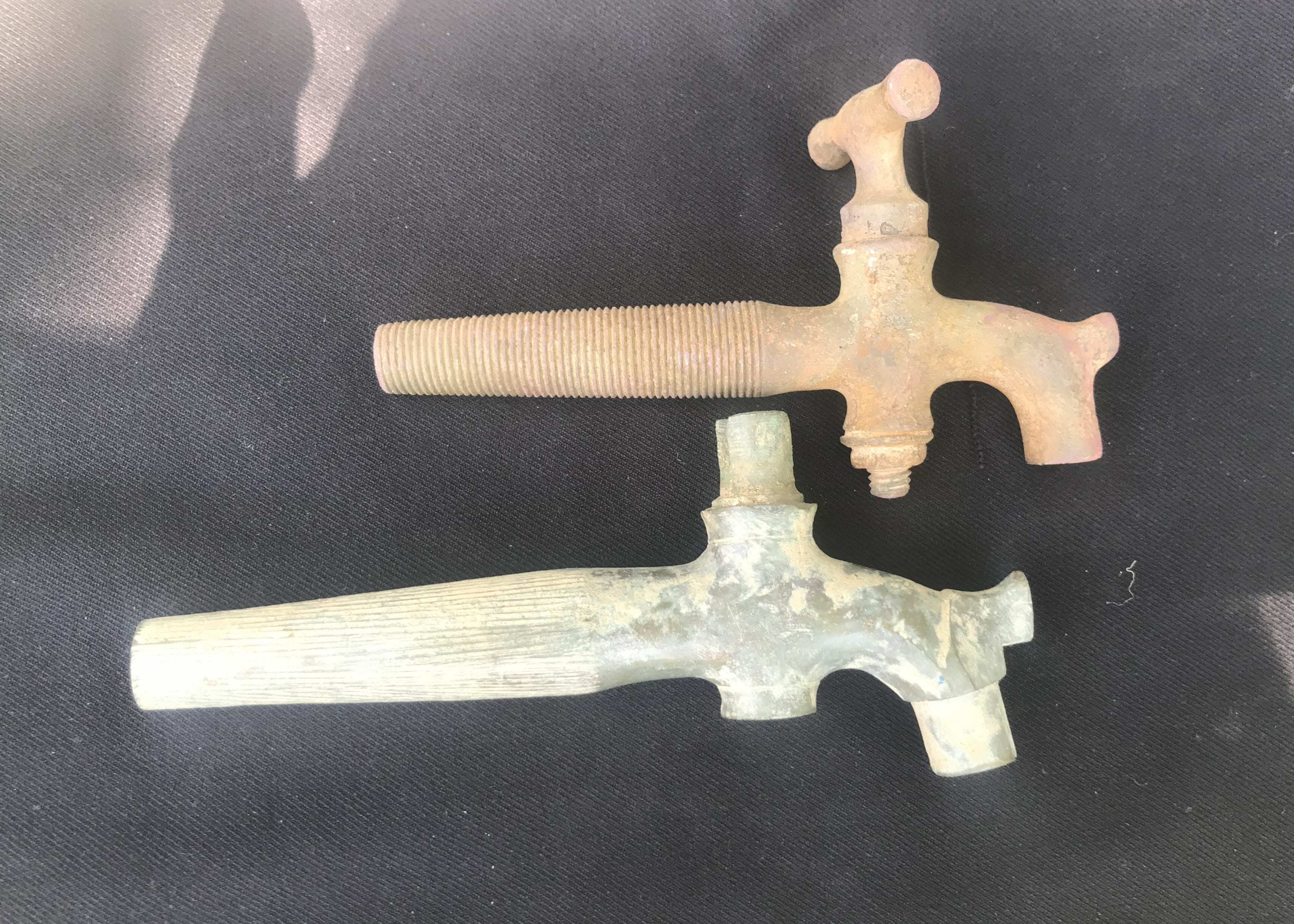
During the 1800s, many liquids were stored or shipped in wooden barrels. These included whiskey and bourbon, rum and brandy, wine and beer, molasses, syrups, vinegar, whale oil (shipped heavily from coastal ports for lighting and lubrication) and even petroleum products.
To dispense the contents, a spigot, faucet, or valve could be fitted into the barrel. One common name for this device is a “barrel tap.”
The tapered end of the tap was driven into a prepared opening in the barrel, usually with a wooden mallet. Its shape helped create a tight seal. A second, smaller opening could then be made near the top of the barrel to admit air, allowing the liquid to flow more freely instead of stopping or “glugging” as a vacuum formed inside.
The barrel could then be placed on a stand or cradle with the tap positioned near the bottom.
I found the tap on the bottom near the former location of a tavern shown on an 1872 map. The tavern is long gone, so I can’t say with certainty that the tap came from it, but the location makes for an interesting possibility. At the very least, it is easy to imagine barrels being opened and emptied there more than 150 years ago.
The Victorian Hand Mirror


The Art Nouveau Hand Mirror
My next piece is the remains of an Art Nouveau hand mirror, probably dating from around the turn of the twentieth century. Unfortunately, the mirror glass and most of the handle are gone, but the decorated metal back is beautiful and more or less intact.
When I first pulled it from the ground, the mirror side was facing me, and I thought I had found nothing more than a large hunk of junk. When I turned it over, however, I discovered an elaborate high-relief design of a woman’s face surrounded by flowing hair, flowers, leaves, and curling vines. I also noticed monogrammed letters that I believe are IES.
After doing some research, I found another mirror online with exactly the same design. It was described as a silver-plated Art Nouveau vanity mirror. Although I haven’t been able to identify its manufacturer, the style suggests that it was probably made around 1900, give or take several years.
In addition to the monogram, the design includes poppy flowers and seedpods, both popular subjects during the Art Nouveau period.
Even broken, it is an attractive piece. It is also one of those finds that makes me wonder about its original owner. Was it used every morning at a bedroom dressing table? Was it a treasured gift? Did its owner reluctantly throw it away after the handle or glass broke?
I’ll never know who once looked into it, but more than a century later, the face on the back is still looking out.
The Winchester Flashlight
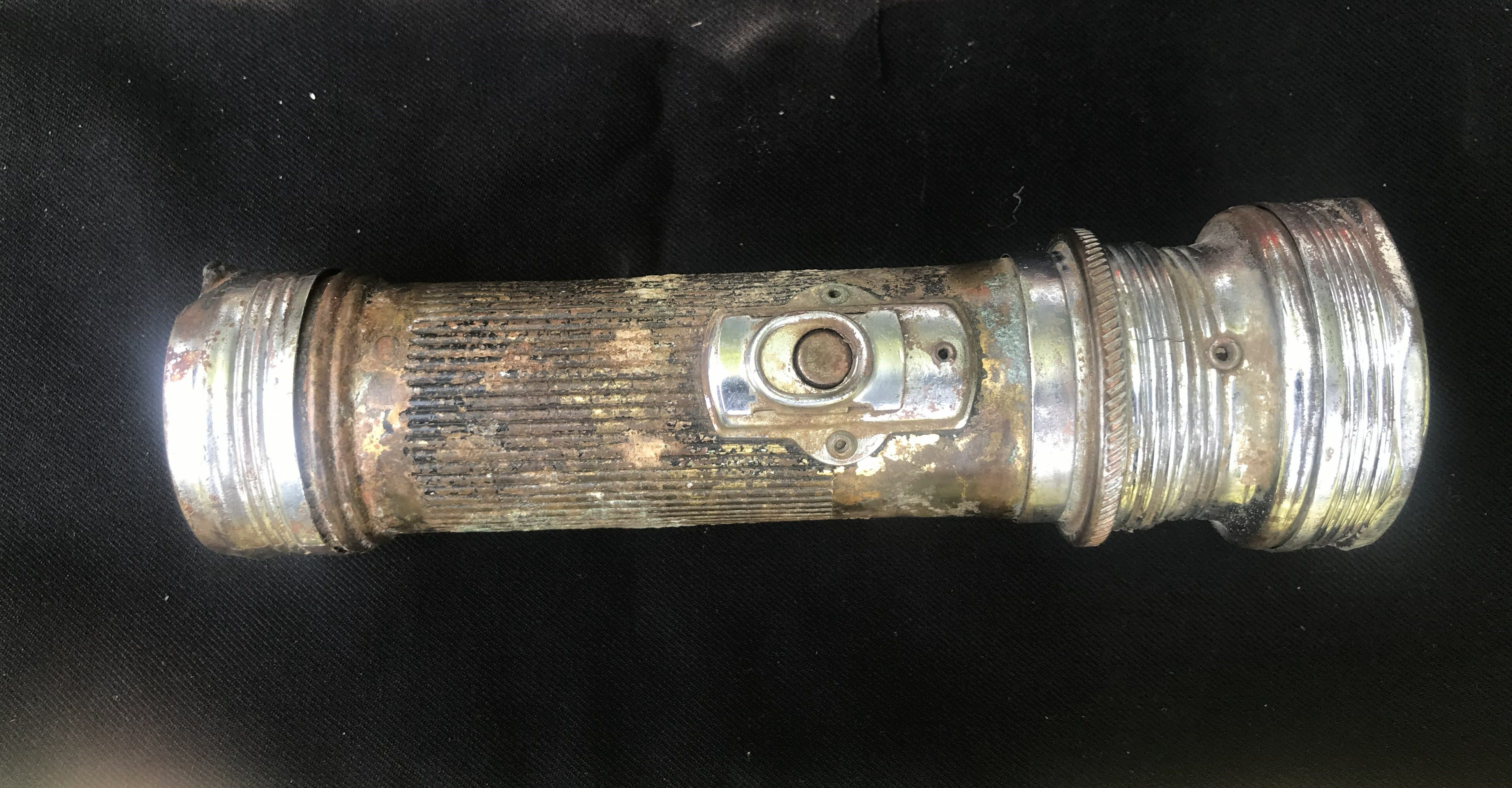
My fourth find is a Winchester flashlight.
The Winchester Repeating Arms Company is best known for firearms, but after World War I it expanded into a wide range of consumer products. Beginning around 1919, Winchester-branded merchandise included tools, knives, fishing equipment, roller skates, household goods, and flashlights. These products were sold through Winchester stores and independent retailers.
The company’s expansion into general merchandise did not prove as successful as its firearms business. Winchester eventually entered receivership, and the Western Cartridge Company purchased it in 1931. The product line was then reorganized and reduced as the company returned its attention primarily to firearms and ammunition.
Based on photographs of similar examples, I believe my flashlight dates from the late 1920s or early 1930s. Without a model number, patent marking, or catalog match, that date should be treated as an estimate.
There is no way to know exactly when it was lost, but considering how long it may have been in the ground, I think it is in remarkably good condition.
The Mystery Spoon
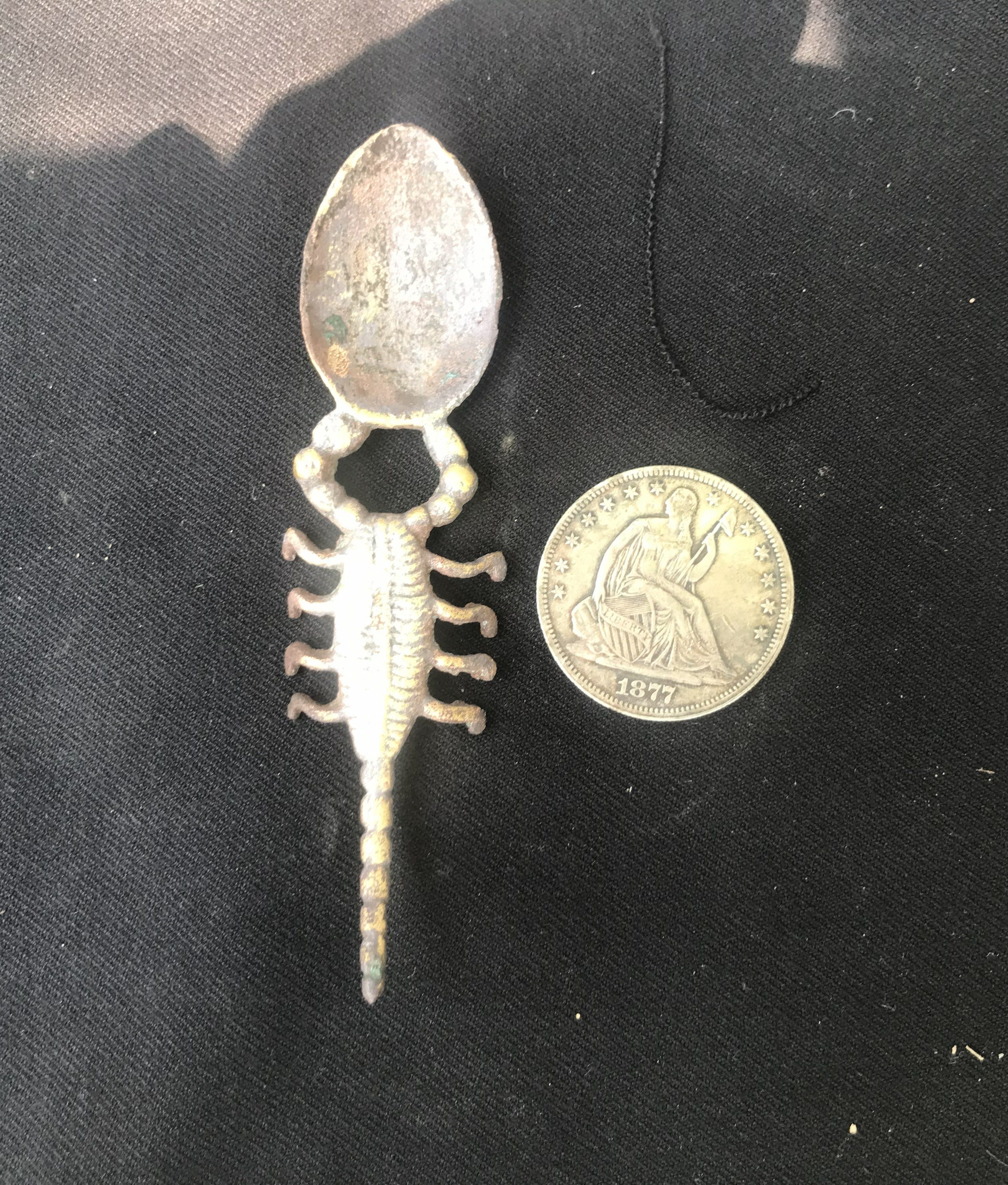
The last of these five artefacts is the best, in my opinion. By “best,” I should probably say “oddest.”
I recently pulled this little rascal from a nearby creek. At first, I thought it was simply a small baby spoon, which I would have been perfectly happy with if that were all it was.
When I got home, I cleaned it just enough to reveal its details and began researching it. That research produced two intriguing possibilities, although neither identification is certain.
One possibility is that it is a small ceremonial scorpion spoon of Indian origin. Various forms of ritual spoons have historically been used to offer water, oil, ghee, or other substances during religious ceremonies. Many examples I found online were longer than mine, however, and some had images of deities, including Krishna, incorporated into their designs.
Even if the spoon resembles those examples, resemblance alone does not prove that it served the same purpose. If it did originate in India, though, how did it end up in a creek in south-central Pennsylvania?
The second possibility, and an equally mystifying one, is (wait for it, and I’m only including this because it showed up on Google) a late 1800s opium spoon. I have found a few other objects dating to the late 1800s in the same section of creek, so the spoon may be that old.
In the late 1800s, the dangers of opiate dependence were not as well understood as they are today. Doctors widely prescribed opium preparations and morphine for wounded soldiers, as well as for pain, sleeplessness, coughs, digestive illnesses, and many other complaints. Morphine was also administered with the relatively new hypodermic syringe, particularly during and after the Civil War. In addition, opium-laced patent medicines were widely available as over-the-counter remedies, sometimes without their narcotic ingredients being clearly disclosed. As a result, opiate dependence became a serious and widespread problem in the United States.
Small spoons were sometimes included among opium-related utensils, but their precise uses varied. Some may have been used to scoop or handle prepared opium, while others may have been used to consume opium paste mixed with syrup or another liquid. Opium-smoking sets could also include specialized tools such as needles, spatulas, knives, scrapers, and small scales.
Surviving objects described as opium spoons were made from materials including brass, bronze, silver, jade, bone, porcelain, and bamboo. They were sometimes highly decorative. However, identifying one from appearance alone can be difficult because many small cosmetic, medicinal, ceremonial, salt, condiment, and souvenir spoons resemble objects now advertised online as “opium spoons.”
For the moment, I think the most honest identification is simply: “small mystery spoon of unknown age and purpose.”
Researching the Finds
Without the internet and Google, I would still be completely in the dark about some of my finds, especially when trying to determine when they were manufactured and how they may have been used.
That is part of the fun, though. Finding an object is only the beginning. The next step is trying to uncover its story.
Great finds! I especially love that spoon… according to chatgpt, the insect motif was something that became fashionable in the late Victorian period.
During the late 1800s there was enormous fascination with:
* beetles
* dragonflies
* spiders
* scorpions
* Japanese-inspired (“Japonisme”) art
* natural history
Novelty silverware featuring insects became surprisingly popular.
This could have been:
* a salt spoon
* mustard spoon
* condiment spoon
* souvenir spoon
* collector’s piece
The ring between the bowl and body is decorative and fits Victorian aesthetics.