
First Half 2026 Finds


With the end of the month approaching, I thought I’d do a quick blog on some of my better finds from 2026. Unfortunately, I haven’t found any older silver coins yet, but I did find a couple old copper coins, including my second oldest British copper. It’s a King George I, and he ruled Britain and Ireland from 1714 to 1727. His copper coins included the halfpenny and the farthing. I’m not sure which this is, but it’s dated 1724, and considering it may have been lost around 250 years ago, it’s in really good condition. It was found on public land, near a known route that settlers used to travel west. In the 18th century, a pack train or wagon train rarely made even 20 miles per day. They preferred to spend the night near water, and there was a small stream nearby the location where this coin turned up. With all those clues, I have to surmise that it was dropped by some passing trader or settler.
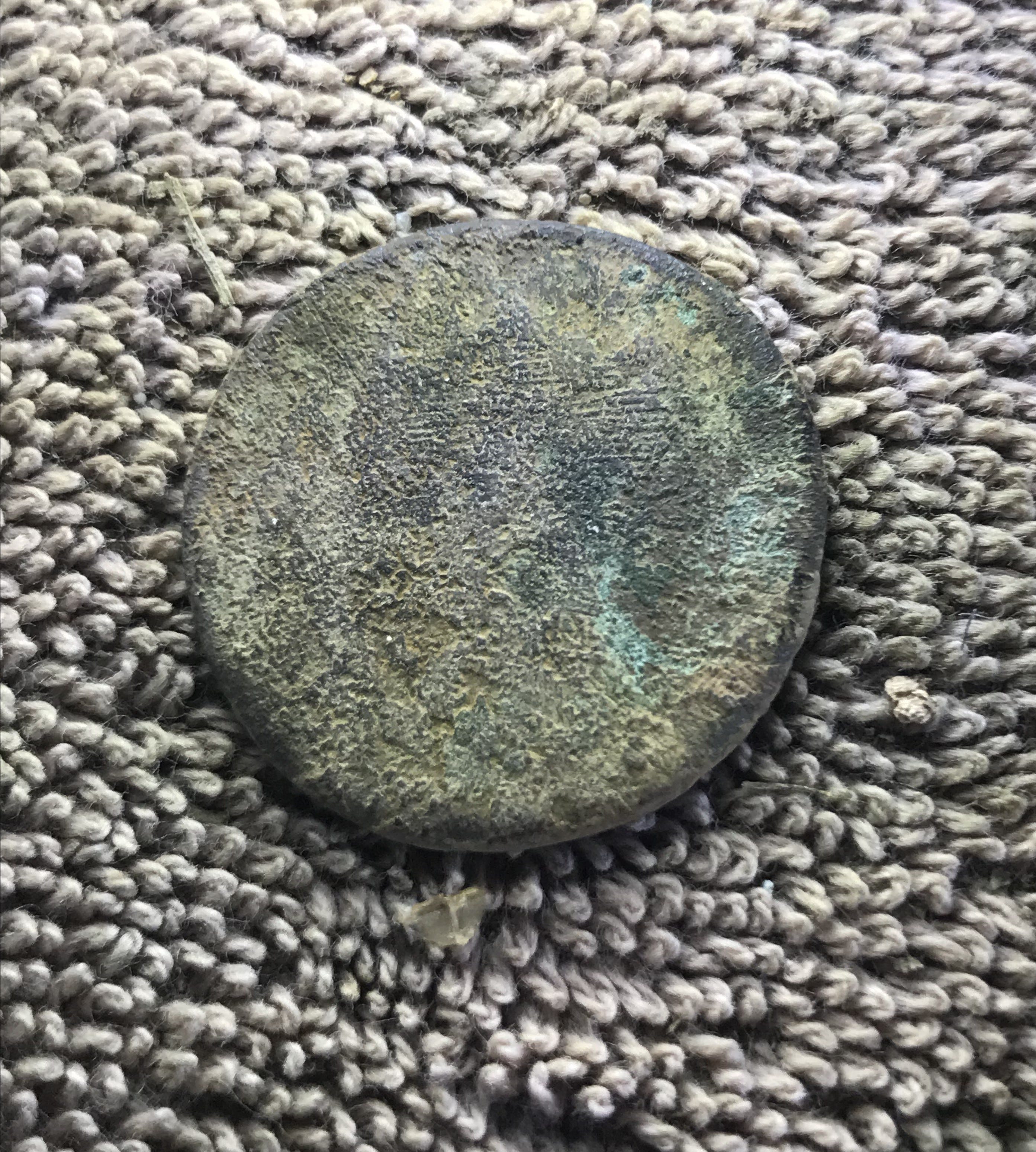
Another copper I found (at an elementary school, believe it or not) is a New Jersey copper. The United States Mint did not deliver its first circulating coins until 1793. Before the Constitution took effect, several states issued copper coins under the Articles of Confederation, with Congress retaining authority over the alloy and value of coinage. New Hampshire was the first state to do so, but few of its copper coins made it into circulation. The only known specimens are dated 1776. Imagine the value of one of those in even poor condition. In the period from 1785 to 1788, Vermont, Connecticut, New Jersey, and Massachusetts all minted their own copper coins. There were a number of types and varieties that were struck. Unfortunately, the coin I found is in such bad shape that all I can make out is the faint shape of a shield, which only appeared on New Jersey coppers.


One really unusual find is a pin for the Kansas City Karnival Krewe. It was a historical, humorous, and festive organization established in 1894. It operated in tandem with the city’s famous Priests of Pallas’ celebrations. Because of its overly boisterous activities, the Krewe was officially disbanded in 1903. Although the initials spell KKK, it was not affiliated with that KKK. This particular pin is dated 1896. How it ended up in the middle of the woods in south-central Pennsylvania is anybody’s guess.
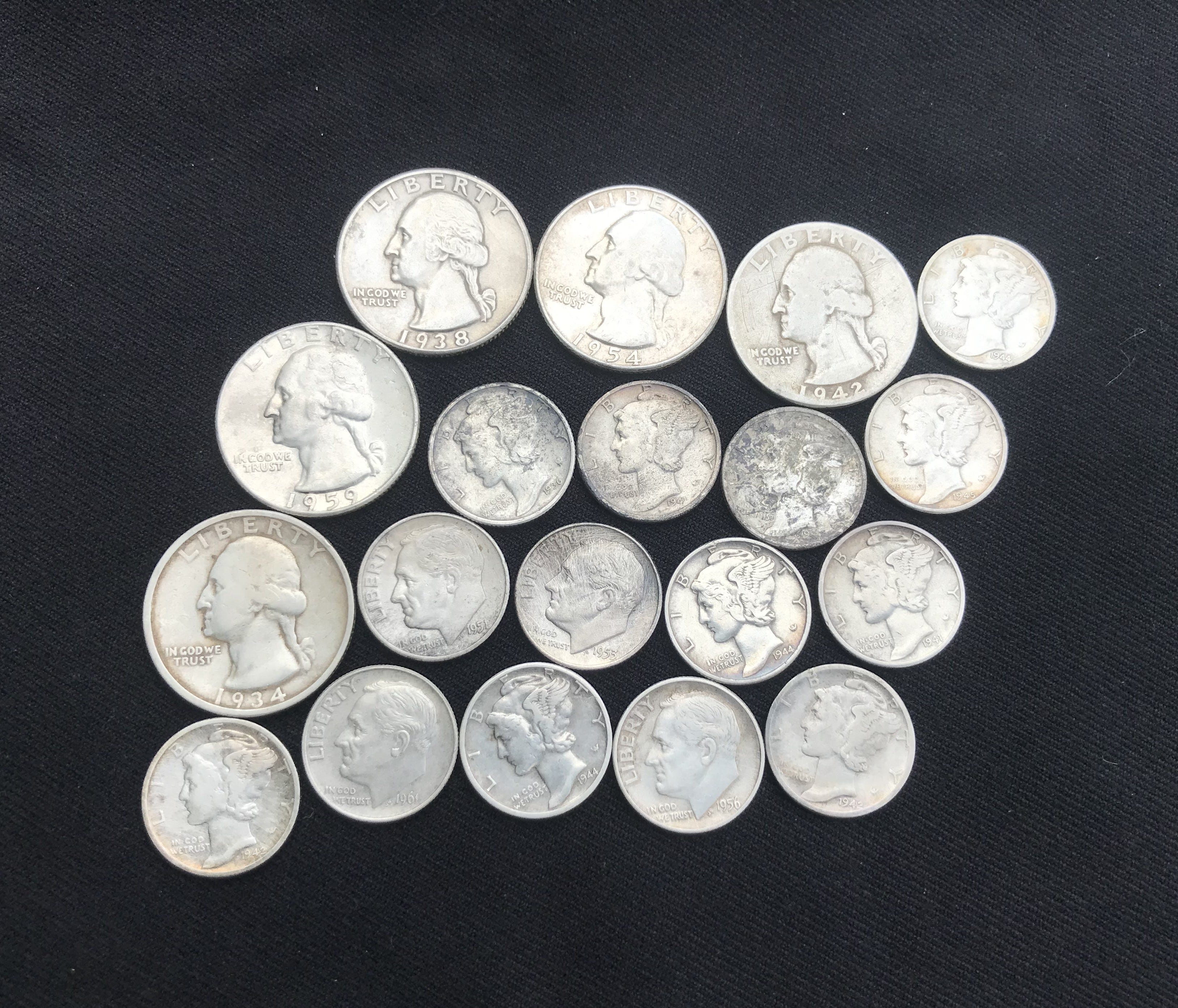
Although, as I mentioned above, I haven’t found any particularly old silver coins so far this year, I did make a small haul of 20th century silver coins over the past 6 months (pictured above). Melt value would be around $113.00 at the time of writing. ‘Nuff said.
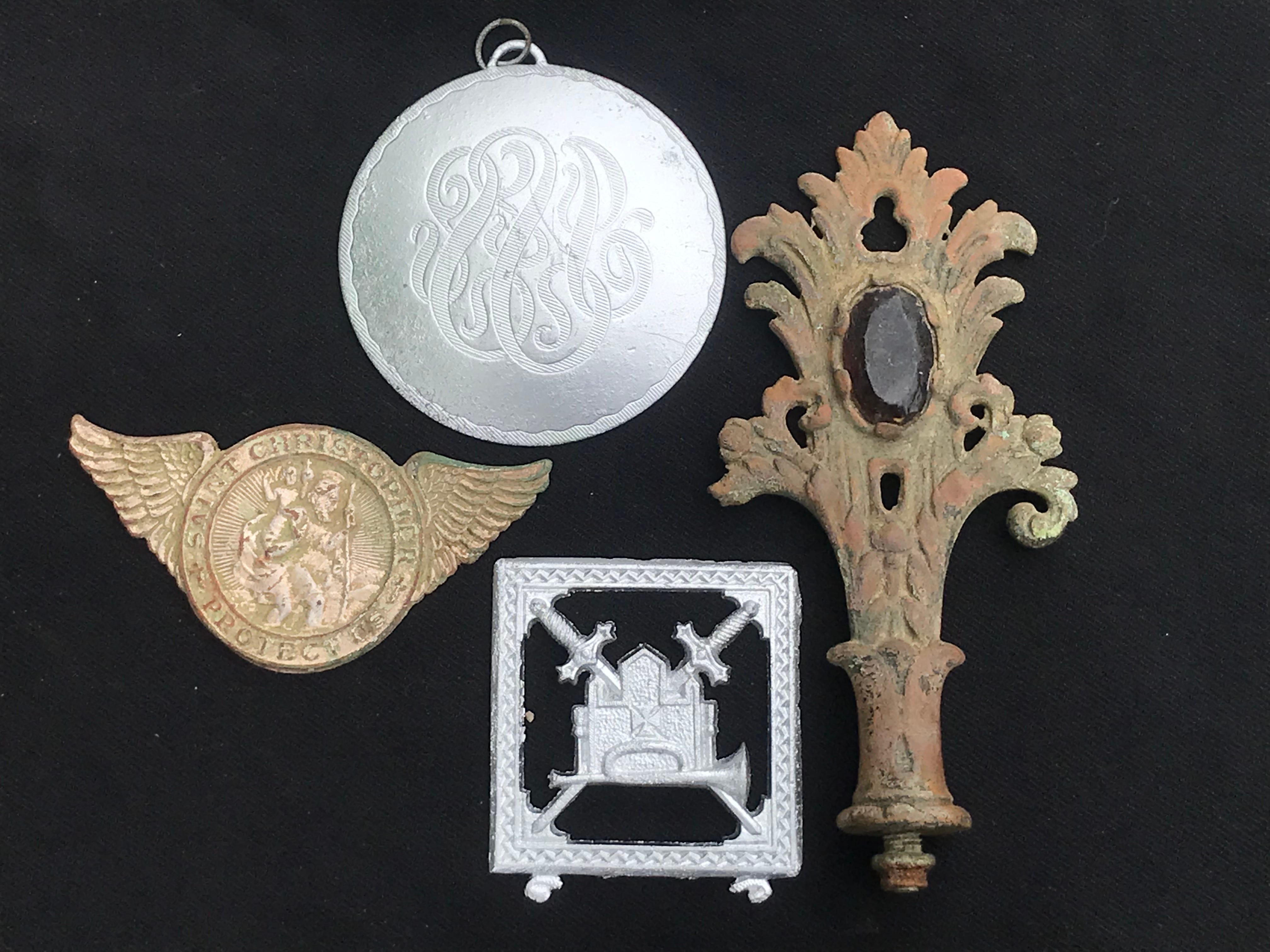
I’m not sure what any of these pieces are, so if you know, please leave a comment below.
On the left is a Saint Christopher emblem, which may have been an automobile emblem from 1950, as a like item is being sold on eBay as such. I’m not sure of the date or usage, but it very well could have been the same. Google Lens says it was traditionally clipped to sun visors or permanently attached to the dash as a form of protection for the traveler.
At top center looks like a necklace embellishment, but at 2.5 inches in diameter is really large for that so maybe not.
The stone on the item on the right is amber colored when held up to the light. This is made of cast brass, and was possibly a picket fence topper, the end of a curtain rod, wall sconce, or chandelier enhancement.
And the item at the bottom has a castle in the center, two crossed swords behind and a horn in front. There are no apparent attachment points anywhere, so I don’t believe it was jewelry. Google Lens says it might be a military unit crest from World War II or a heraldic pin.
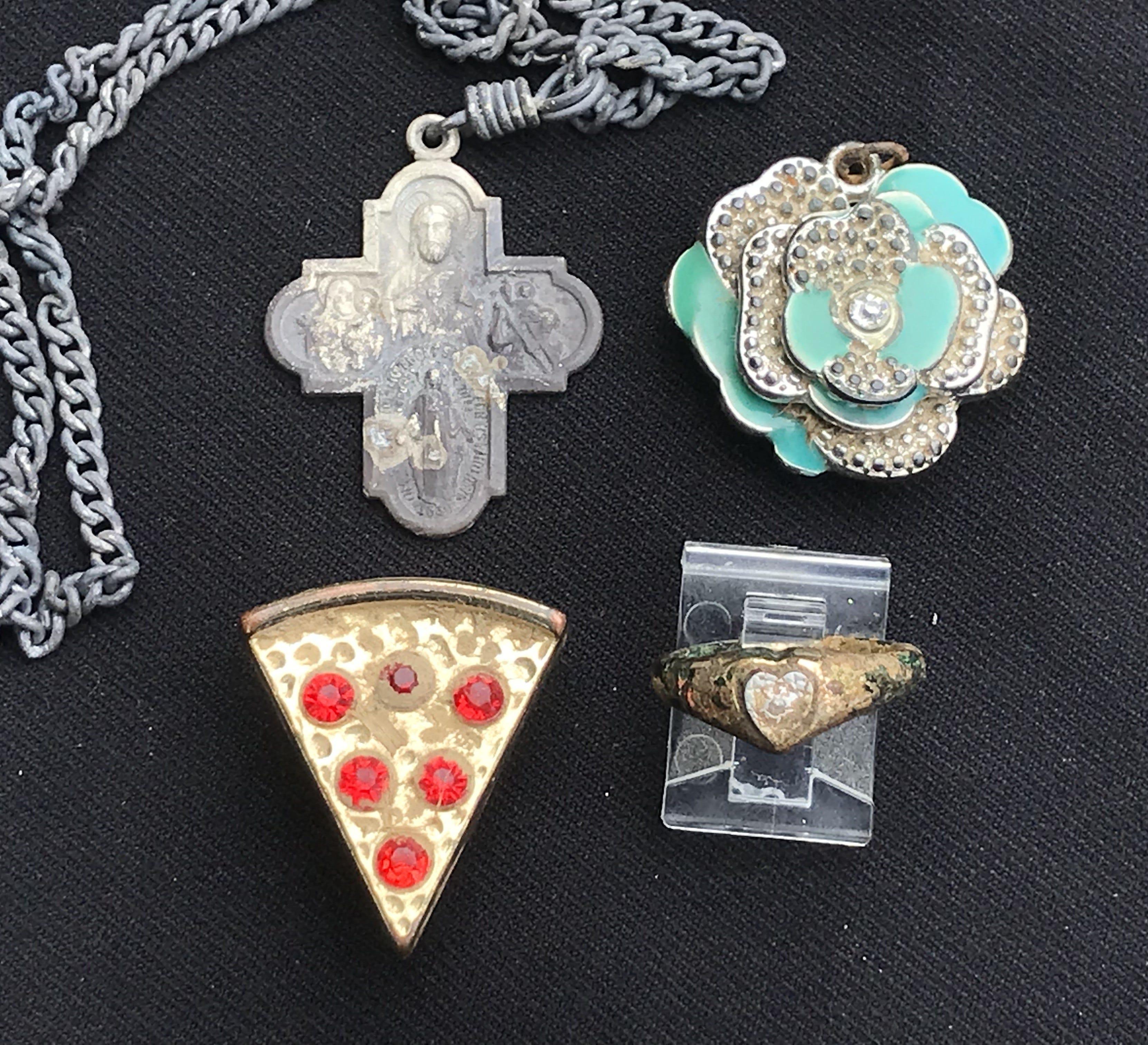
Pictured above are some of the “bling” I’ve found so far this year. On the top left is a sterling silver religious medallion.
On the top right is a necklace embellishment in the shape of a flower. I suspect that it’s sterling and enamel with a glass or crystal centerpiece. It’s very reminiscent of Avon jewelry, but there are no Avon markings, and a search shows no similar item listed in an Avon search.
On the bottom left is a cute little slice of pepperoni pizza that was found in a schoolyard. The stud on the reverse says “Made in China,” Jibbitz, Inc., and “C19-08-2023,” which is presumably a date. In the exact center is a circle with the line through the center, a frowny face, and the numbers 0-3. Jibbitz are shoe charms that are pushed through the holes in Crocs and other similar shoes, and are often worn by children to decorate and individualize their shoes.
Bottom right is a small ring that looks like it may have been gold plated. There’s a tiny crystal stone in the center of the heart. It was found in the deep woods, not near any public location.
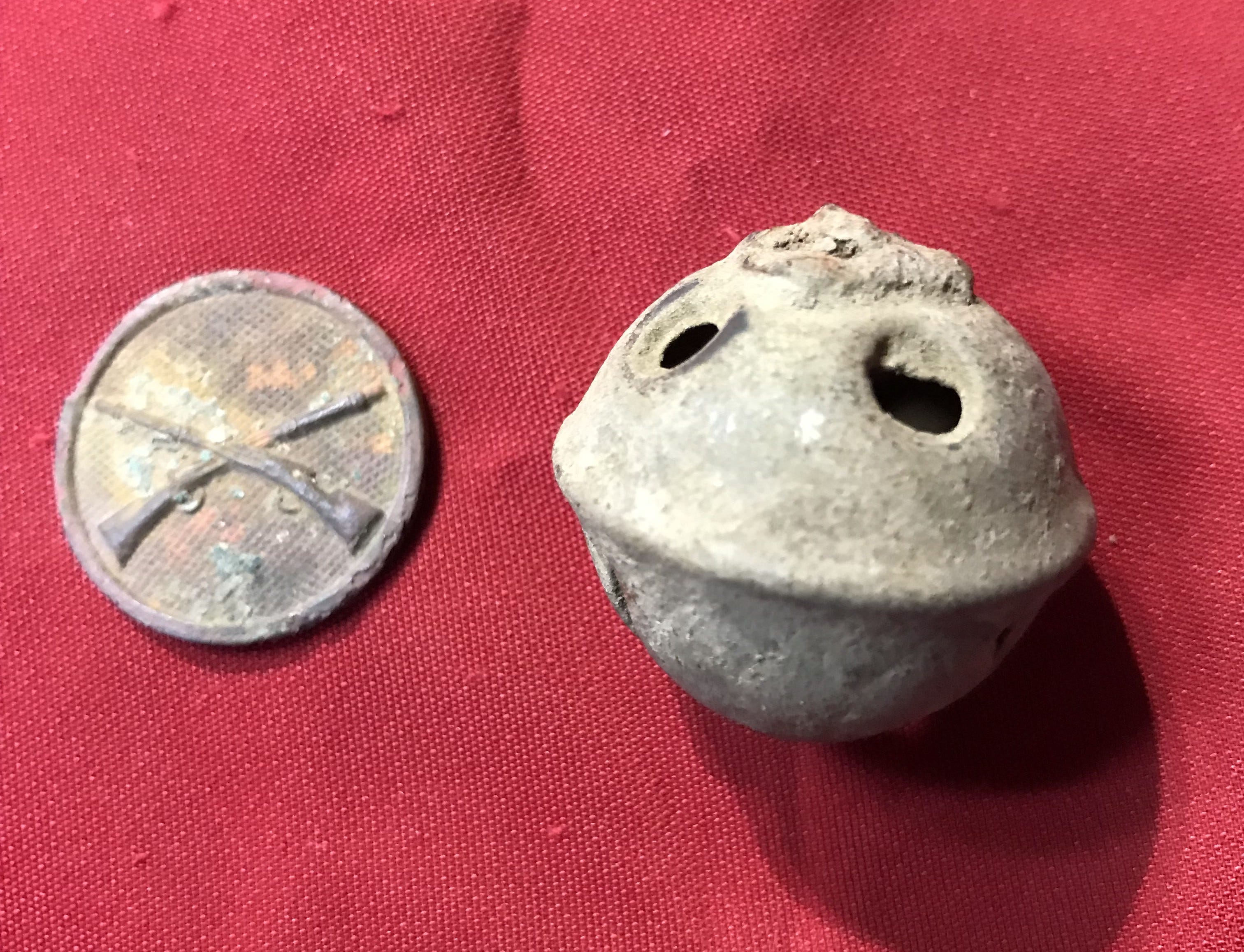
On the left is a military collar disc from the World War I era, I believe. The crossed rifles indicate Infantry. For more on military memorabilia, check my post on Military, Two-Piece, Blow Hole, and other Buttons, and (for a slightly different era) this one on Civil War Artifacts.
On the right is a small crotal bell that still has the little ringer piece inside, and it still makes noise! Crotal bells are among my favorite relics to find. I’ve got a post on those, too, if you’re interested in seeing others from my collection (link just above).
Both of these were found at an old abandoned home site.


This lamp produced light through a reaction between calcium carbide and water. That reaction created acetylene gas, which burned with an intense white flame. For a deeper, fascinating description of how these lamps worked, see my post Carbide Lamp (Acetylene Gas Lamp). There’s a chance these were also used as headlamps on early motorcycles. If you know anything about that, please let us know here.
I usually research mystery pieces such as these using a combination of Google and by searching similar items on eBay. If you have any other suggestions for where I can research, please drop me a line!
You had quite a successful 1st half of the year. Congratulations on all the silver and wish you double success for the rest of the year.
Such interesting finds! Keep up the good work!