
Angling Finds
Or Fishing for Lures

If you’re an avid follower of my blog posts (and I hope you are), you will recall that I’ve mentioned in one or two of them that I like to detect creeks and streams in the summer. Probably 90% of my water finds are fishing-related, but on rare occasions I’ll pull out something exciting. See my blog on the love token.
Today, I’ll show off my angling finds.
Quick history lesson: The term “angler” comes from the Old English word angle and the Proto-Germanic angul, which originally meant hook or something bent. By the mid-15th century, it evolved into an occupational term for a fisherman who uses a hook and line.
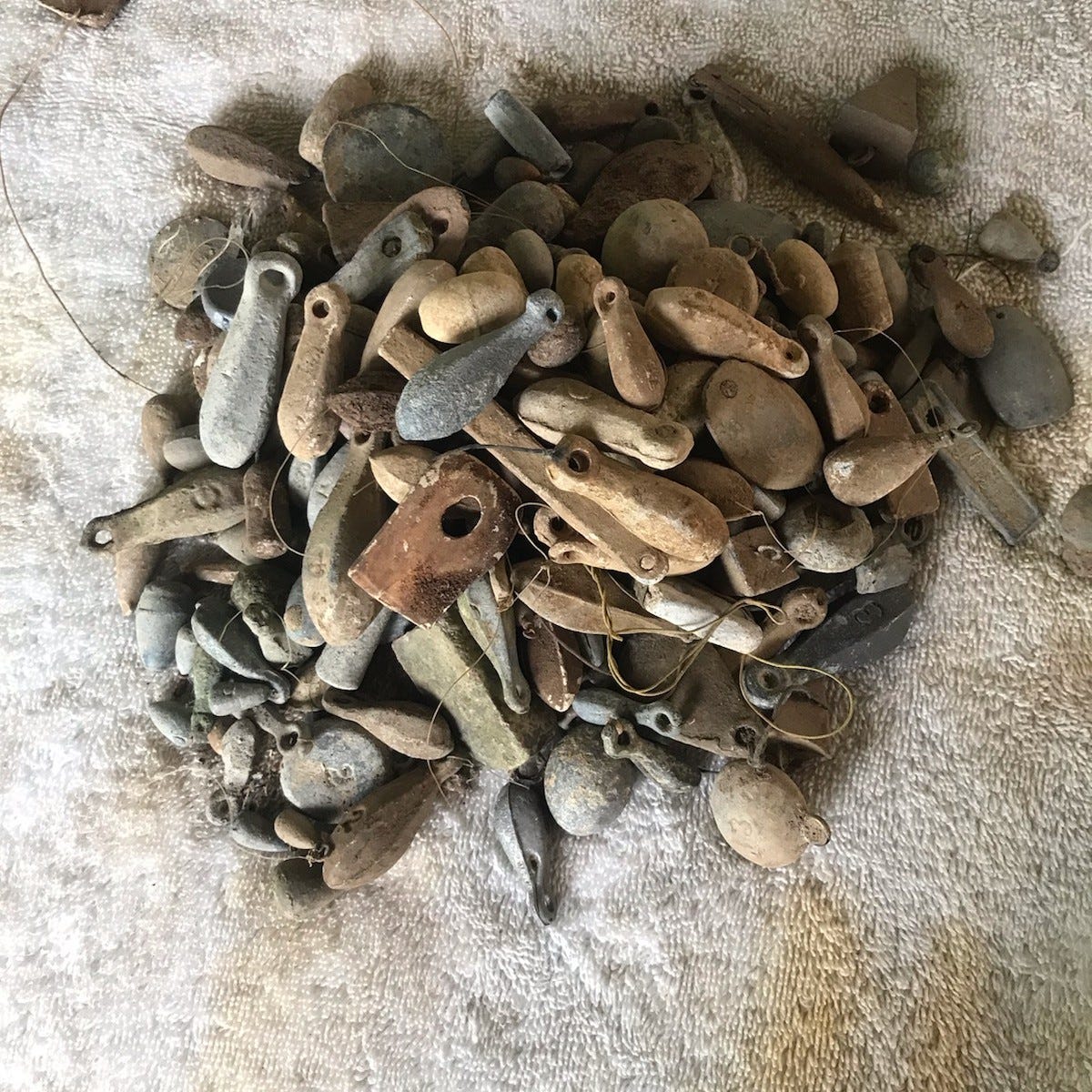
The items most often found are fishing sinkers. The majority are just the basic store-bought kind. Once in a while, I’ll find a homemade one or an odd-shaped one. The generic ones I put in my scrap bucket, but I keep the unusual specimens. The reason so many sinkers are found is two-fold: first, the sinkers have enough weight that it allows them to drop into small fissures and crevices, where they become stuck. Second: the hook might catch on a log or rock, and then after the line breaks, the hook soon rusts away. But lead weights last forever.


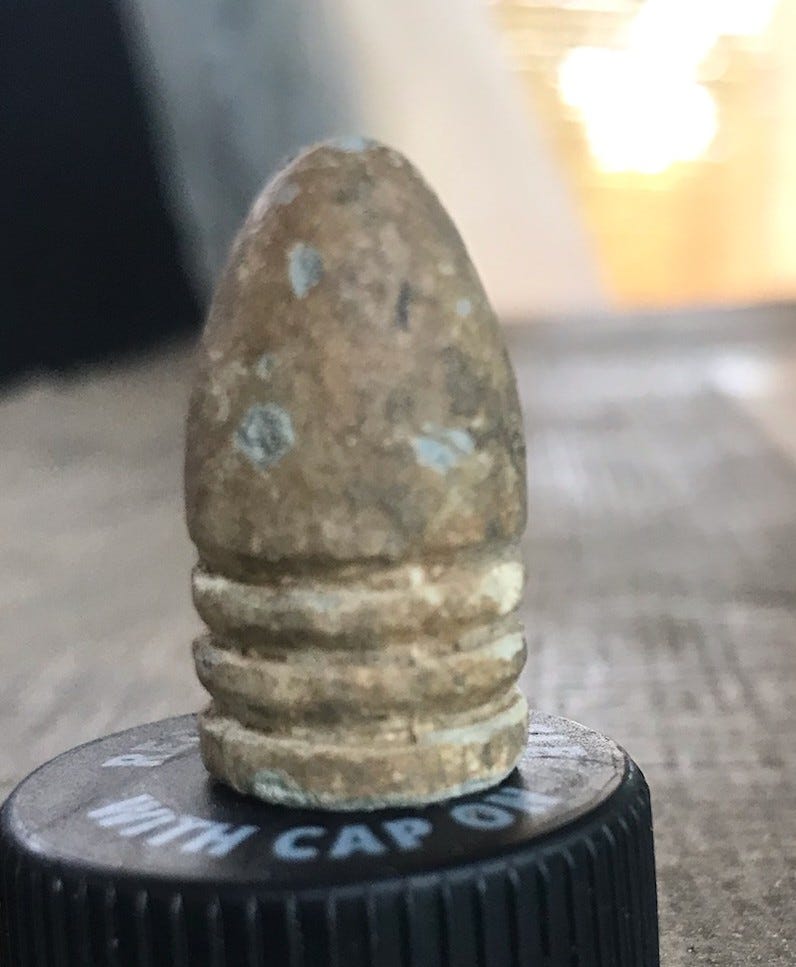
I’ve seen photos of civil war bullets made into sinkers, but I have yet to find one.
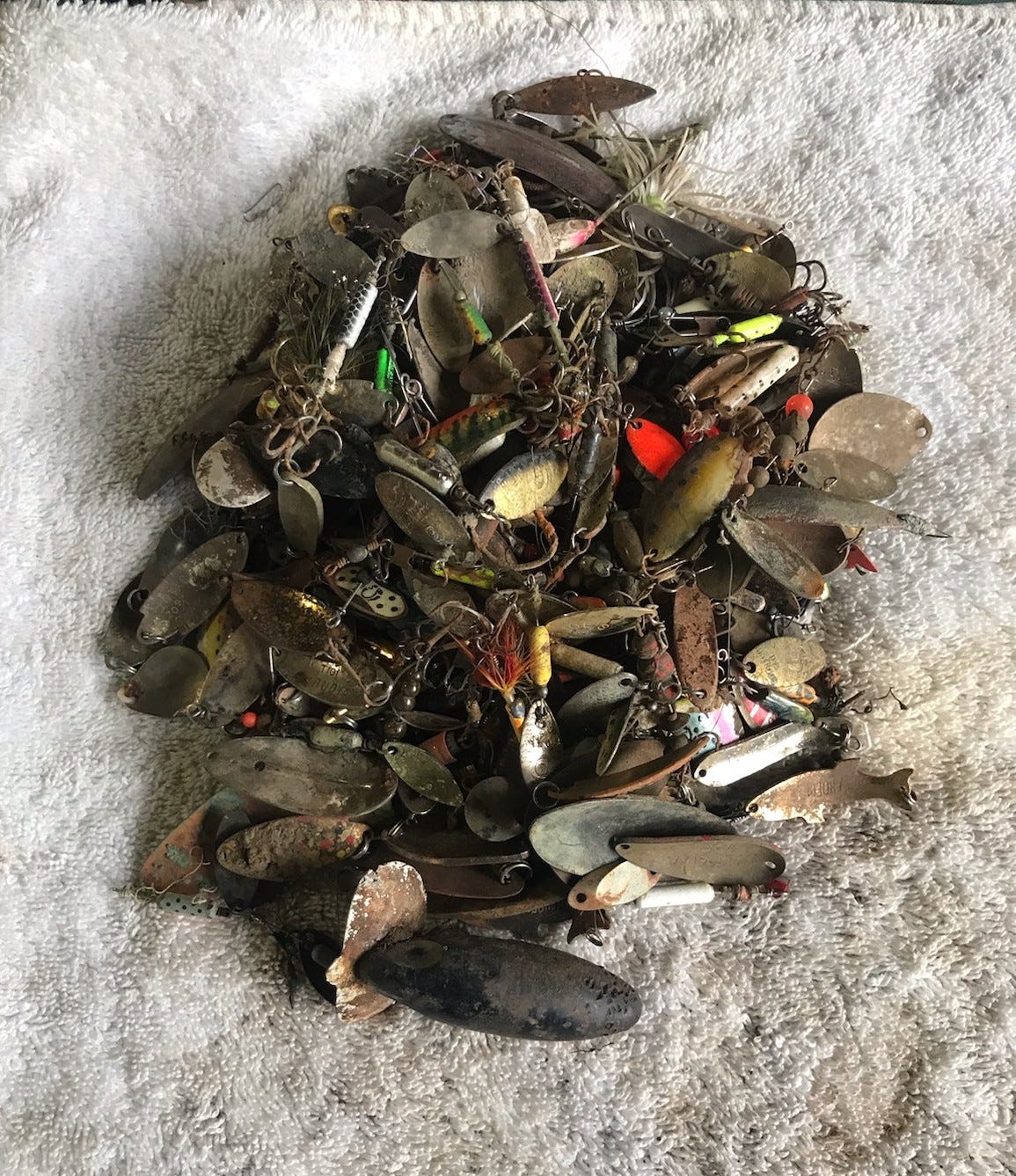
Along with sinkers, I find a lot of lures. As and angler myself, I can occasionally find an old lure in good enough shape that I can reuse it, either directly as found, or by putting new hooks on them. I only use lures when fishing, so I don’t reuse sinkers.
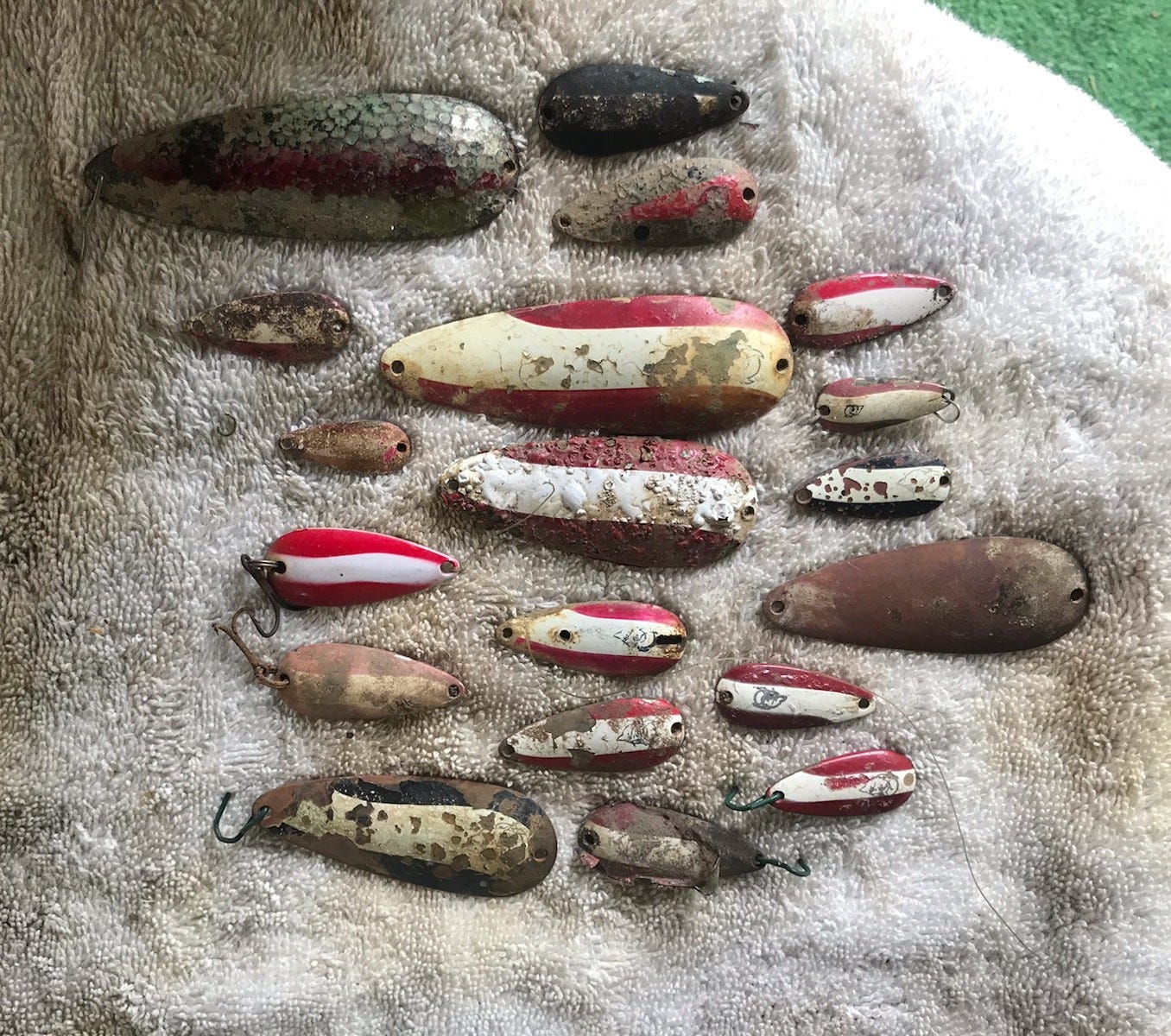
One of the more common finds among lures is the Dardevle. The original fishing lure that eventually became the Dardevle was invented in 1906 by Detroit taxidermist and angler Lou Eppinger. In 1906, Eppinger spent a month in the Ontario wilderness and hammered out the first brass prototype by hand. It was designed to be heavier on the outer edges and thinner in the middle, creating a unique wobbling action that fish found irresistible. (As a side note, another source says this lure is designed to be thinner on the outer edges and heavier in the middle, but I can’t tell by looking or feeling that there’s any change from side to side or end to end.)
In 1917, Eppinger began marketing and selling the hand-stamped design commercially out of his Detroit shop. It was originally named the Osprey and was only sold in black and white. A year later, in 1918, he renamed the lure to “Dardevle”. The new name was inspired by the nickname Allied troops gave to the U.S. Marines during World War I as Dare Devils. The spelling was intentionally altered to Dardevle to avoid religious objections to the word “daredevil”. The general style is also known as a “spoon”.
Today, the classic red-and-white striped Daredevle is produced in Dearborn, Michigan, by the Eppinger family, continuing a legacy that spans over a century. You can view their full catalog on the Dardevle by Eppinger website.
Considering that this lure has been around well over a hundred years, it’s no wonder I find so many of them.
A couple of years ago, I pulled this reel out of a local creek. Unfortunately, I can’t find a manufacturer or maker mark on it at all, so there’s really no way to date it precisely. How does somebody lose a whole reel? It’s baffling to me.


Considering how popular the activity of fishing is, it’s no wonder that so many things get lost in the water. Have you ever lost (or found) anything interesting while fishing?
Just today I was walking over a bridge in the Irish town near where I'm staying, and a kid was on the banks below. He had somehow dropped his entire fishing pole in the water and was trying to retrieve it. It was lying on a bed of seaweed just off the shore. But the banks were covered in mud and mussel shells, and with every step in bare feet you could tell it was painful. As he got closer to the water he started to sink in the mud. I continued on my way so I don't know if he was able to complete his quest to rescue the fishing pole. But in a couple decades there may be another reel under there for someone to find.
Also, and I am 100% serious, just beyond the fishing pole was a whole entire bicycle sitting in the seaweed bed just under the water.